Roads & bridges
Client: New Zealand Transport Agency (NZTA)
Contract value: NZ$335m
Contract type: Design and construction
Completion date: Ongoing (2010-2015)
Promising, efficient & safe
Connecting people via our involvement in important infrastructure is an important part of our work at Fulton Hogan. The Tauranga Eastern Link is a 23km, four-lane motorway being constructed in New Zealand’s Bay of Plenty region. The new road replaces a section of State Highway 2 and promises more efficient, safe transport between local communities.
This highway is recognised by the government as a road of national significance, with the Tauranga Eastern Link recognised as Bay of Plenty’s largest roading project and a key strategic transport corridor for the evolving region.
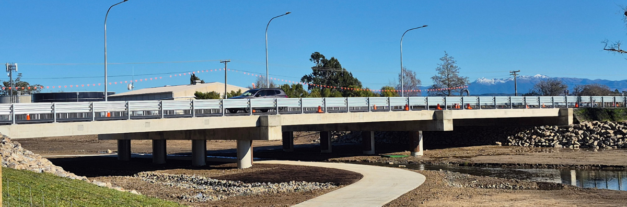
This project utilises Fulton Hogan’s extensive experience building roads and bridges, to construct over 550,000m² of new road, 3,000,000m³ of earthworks, and construction of eight bridges. New intersections will be constructed for Sandhurst Drive, Domain Road, and Paengaroa junction (SH2/33), as well as a new overbridge for Parton Road, and underpass for Maketu Road. Extensive landscaping involves planting approximately 300,000 native plants – part of our commitment to minimised environmental impact and maximum sustainability.
When completed, the project will support regional growth by making safer and more efficient connections between Tauranga and Paengaroa – for business, industry and tourism.
Dust control
One of the challenges faced by the project was dust control – especially when preloading open cut sections of the motorway with sand. The traditional method of dust suppression is water, however this project would require a very large volume due to the sheer size and scope. Using a polymer on specific areas was an option, however in this case, not cost-effective.
Our Fulton Hogan team found a solution by taking advantage of by-products of the local dairy industry to introduce a safe and cost-efficient way of controlling dust – minimising risks to the community. Our client was also very pleased that our innovative solution provided a substantial cost saving – with an additional NZ$55,000 trimmed from the original project forecast.
Safety first
Another safety initiative that came out of this project was the TEL bag filling frame, designed to reduce the safety risk from manual handling during bag filling.
At the Mangatawa Interchange, two Mechanically Stabilised Earth (MSE) wall embankments were constructed. Each wall required over 40,000 25kg bags to be filled and transported to the wall site for placement.
This initiative removed manual handling, helped reduce the overall programme by an impressive 50 days and resulted in significant cost savings of more than NZ$120,000. Importantly, no staff were injured throughout the operation.
The team won an award at the NZ Safeguard 2014 Safety Award.